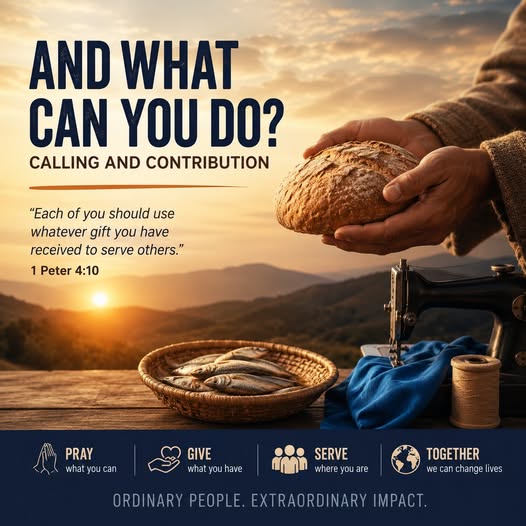
Calling and Contribution
Main Texts: Romans 12:4–8, 1 Corinthians 12:4–27, Ephesians 4:11–16
One of the questions that has remained in my heart for the last few years came through a dream my grandmother shared with me before she passed away.
She dreamed she was sitting in the middle of a room while people entered one by one. To every person she asked the same question: “And what can you do?”
One person answered, “I know how to sew.” And she responded, “Then you will sew uniforms for the youth soccer program.”
For many years I reflected on that dream because she was asking something deeper than a question about skills. She was asking: “What can you contribute?”
Throughout Scripture, God works through ordinary people willing to offer what they have. Moses had a staff. David had a sling. The widow had a small offering. The boy had five loaves and two fish. Dorcas had a needle and thread. Again and again, God works through people who simply offer what they can.
Not everyone can do everything, but everyone can do something. Jesus showed that God values faithfulness more than visibility. A quiet prayer matters. A small contribution matters. A recycled bottle matters. A meal matters. A visit matters. Showing up matters.
Over the years I have reflected on mission work, community service, environmental stewardship, youth outreach, and the vision behind Esperanza Foundation International. Sometimes the needs feel overwhelming. Poverty. Loneliness. Broken relationships. Environmental damage. Young people needing guidance. Communities needing hope.
People ask: “How can one person really make a difference?” Maybe the better question is: “What can I do?”
I remember sharing the early vision of Esperanza with an elderly friend from church named Margaret. I told her: “Imagine if instead of one person feeding five thousand people, we became five thousand people each bringing five loaves and two fish.” I added: “If each person contributed even forty dollars, together we could do so much.”
She replied: “I will give my forty dollars from my pension. Come pick it up before I spend it because I will probably need it soon.” Others said, “Not right now,” “When it gets started,” or “After others contribute.” Margaret was willing to give immediately from the little she had. In the end I did not take the money, but what remained with me was her heart.
I also remember a man I met on a job site. I shared my passion for helping people in El Salvador. He listened carefully and said he respected what I was trying to do and would help. When I mentioned recognition for supporters, he replied: “I would help, but not for recognition. I would help because I think what you are doing is good and I want to support you.”
That conversation taught me that some of the most meaningful acts of service are done quietly—not for applause, attention, or recognition, but because helping others is the right thing to do.
Maybe today God is still asking the same question: “And what can you do?” Maybe you can pray, teach, encourage, mentor youth, volunteer, care for the environment, support mission work, or simply be present for someone who feels alone.
Not everyone brings the same thing. But together, small contributions become something greater than we imagine. In the Kingdom of God, no sincere act of love, service, generosity, or faithfulness is ever wasted.
Perhaps the question is not whether you have enough. Perhaps the question is simply this: What can you do? And perhaps the answer begins the moment we stop looking at what we lack and start offering what God has already placed in our hands.